
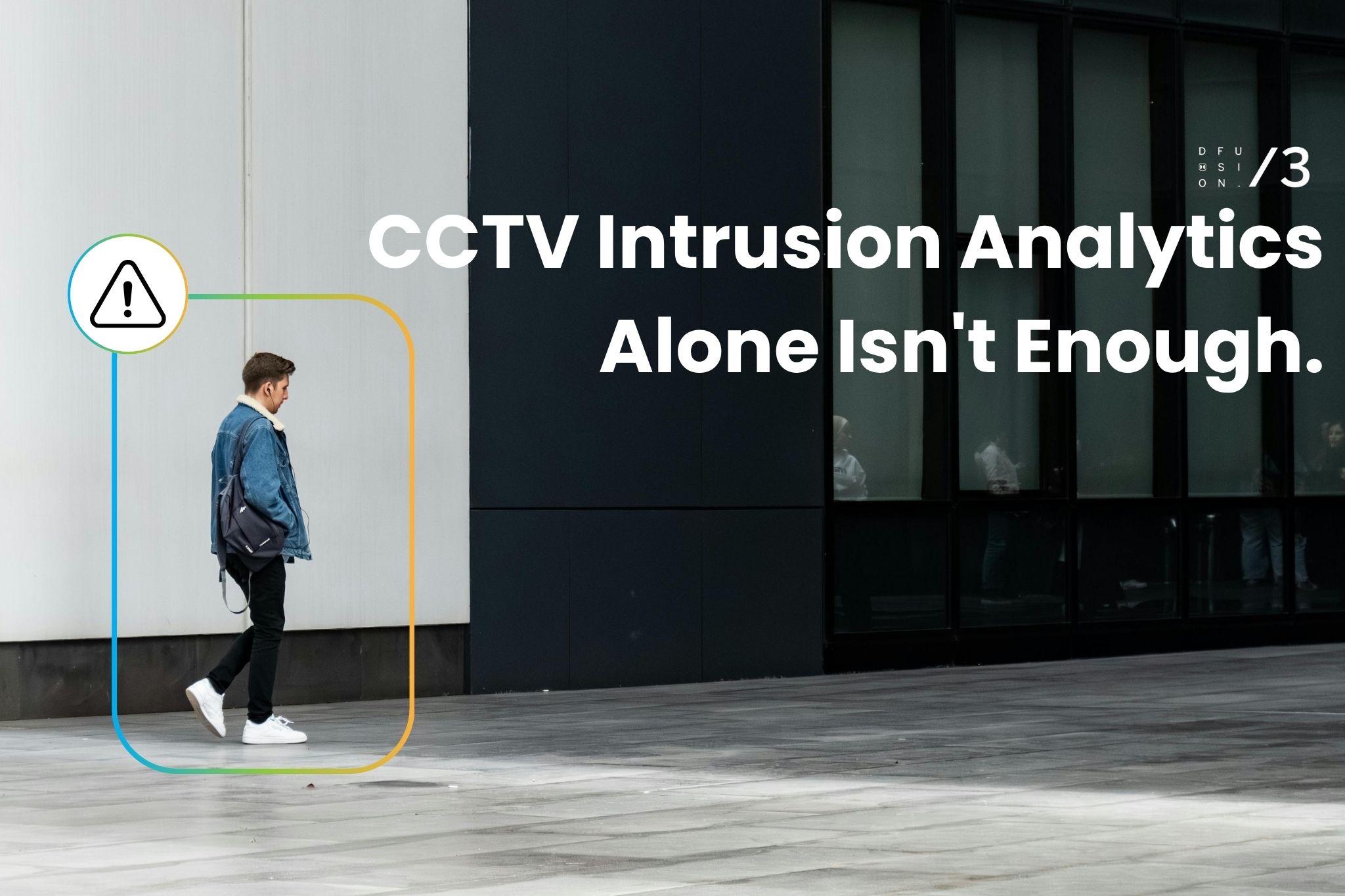

For many years, CCTV has been the primary means of securing sites, often paired with basic video analytics that respond to movement or activity. But simple intruder detection alone isn’t enough, and customer expectations have moved well beyond it. There is growing customer demand for genuine behavioural insight and systems that understand what is happening on site, rather than just reacting to movement. This shift benefits far more than security alone; it extends into health and safety and operational efficiency too. Customers are demanding to use the same infrastructure that can be used for intrusion detection overnight and for monitoring workflows, footfall, or compliance during the day; this gives integrators a single system that supports a much wider range of their customers’ needs.
DAVANTIS DFUSION/3 is built to fix these problems, giving integrators a system that moves their customers’ security from something that only documents incidents to something that can help stop them before they happen, whilst also providing business intelligence capabilities.
Watching VS Understanding.

Regular CCTV analytics usually flags the moment it detects movement, regardless of whether the movement is a threat or risk. All it takes is a bird flying past the camera for an alert to be triggered, and for integrators, that means lots of complaints from customers who are frustrated with chasing false alarms. DFUSION/3 works differently. Instead of detecting movement alone. It uses AI to interpret what the movement is and whether it represents a genuine event. DFUSION/3s dual engine system allows for more complex behavioural understanding, such as noticing when an employee has left an area unattended, spotting a fall or injury, or detecting someone tailgating. DFUSION/3 can also recognise a vehicle or person loitering for a long period of time, or a person being tailgated into a high-security site restricted for some people. In this example, your security technology alerts you rather than being used as a post-incident check. Rather than simply reacting to someone moving, it understands what has moved and whether the event warrants raising an alert, giving integrators a system they can stand by with confidence, reducing complaints and offering more functionality to end users.
Fewer False Alarms.

Standard CCTV set-ups are notorious for false alarms, and this has a direct operational cost for integrators over time. A tree branch moving can trigger the same alert as an intruder. And over time, this leads to operators missing real alerts, wasted response time, and customers losing confidence in the system. DFUSION/3 addresses this with super rules and a Dual AI & Machine Learning engine, so double verification takes place in a split second before the alert is sent, in contrast to edge-based single-engine AI detection systems. For integrators, this means fewer false alarms, lower monitoring costs and a system that customers can trust to flag the events that genuinely require action.
No Need To Start From Scratch.

Upgrading doesn’t mean ripping everything out. For integrators, DFUSION/3 can be added to any existing CCTV infrastructure that is making the system camera-agnostic. This means a simplified setup and no need for end users to lock themselves into a single camera manufacturer or replace all CCTV cameras when modernising ageing site systems. This makes it far easier to get customers to purchase rather than selling a full system replacement, since the existing hardware stays in place and the intelligence is simply layered on top, reducing both cost and disruption for the client while giving integrators a straightforward upgrade opportunity.
Going Beyond Simple Alerts – Data Engine

The true value of Bi3s’ data engine extends far beyond individual alerts. While DFUSION delivers advanced behavioural analytics and real-time notifications for events such as tailgating, slip and fall incidents, absence detection, and other site-specific activities, the data engine transforms this information into meaningful operational intelligence. By bringing behavioural analytics, alerts, sensor data and operational insights together into a single, fully customisable dashboard, organisations gain a complete view of activity across their sites. For example, a security officer can use the platform to identify immediate behavioural alerts and incidents, a site manager can monitor ongoing reports to identify patterns and trends in violation rates, and a regional manager can compare performance across multiple sites to detect emerging risks and report operational performance to senior leadership with confidence and clarity, while every user can track performance relevant to their role through a single, centralised dashboard.
For system integrators, the data engine creates an opportunity to deliver greater value through a branded, managed intelligence service. The dashboard can be customised with an integrator’s own logo and provides a centralised view of multiple customer sites, making it easy to monitor performance, compare locations, and identify emerging risks. Rather than simply responding to alerts, integrators can provide ongoing reporting, trend analysis and actionable insights. This creates recurring revenue while helping customers improve safety, security and operational efficiency.
The Bottom Line

Traditional CCTV answers what happened. A system like DFUSION/3 is built to answer what is happening right now, and whether staff intervention is required. The shift matters more than it may seem, particularly for integrators managing critical infrastructure sites. Most security failures are not failures of recording; they are failures of timing. The footage was there, but no one was watching the moment it mattered, or the alert got lost among a dozen false ones. For these sites, there is a big difference between reviewing a log after the fact and acting straight away to prevent a critical incident or intrusion from taking place, and that difference is often what determines whether an integrator’s system is trusted going forward. This is what the shift in technology is about: moving security from something that documents problems to something that helps prevent them.
 Bi3 partners with IntelexVision to accelerate the growth of the UK video analytics market